A leader in Scottish healthcare innovation has hailed fresh success in Robotic-Assisted Surgery (RAS), calling it ‘a pioneering path to the future’ for the country’s patients.
Following a host of robotic breakthroughs delivered across Scotland in recent times, NHS Forth Valley adopted the state-of-the-art technology on a phased basis from the end of March and has since announced completion of 19 RAS procedures during the last six weeks.
The move has been made possible by £2.5 million in Scottish Government funding, clearing the way for Forth Valley Royal Hospital in Larbert to enhance the delivery of complex surgery across colorectal, gynaecology and urology services, including cancer care, through the installation of a new Da Vinci XI dual-console robotic system.
Healthcare innovation leader InnoScot Health says it believes it is another significant milestone for the country’s ambitions in providing faster, more effective surgery, helping to benefit the wider health system.
Executive Chair, Graham Watson said: “It is pleasing to see NHS Forth Valley joining the RAS revolution happening across Scotland with a dozen health boards now realising its huge benefits – from shorter operating times, reduced blood loss, and a lower risk of complications, to less post-operative pain, shorter hospital stays, and faster recovery times.
“RAS represents nothing less than a pioneering path to the future of healthcare with its heightened precision and magnified 3D vision of the surgical field, all directed by surgeons’ expertise.
“So far, it is also merely the tip of the iceberg in terms of what more can be achieved through this technology going forward, with AI-powered ‘copilots’ helping to anticipate any risks and identify optimal approaches, prediction of tissue motion in real-time, and telesurgery allowing procedures to be performed more remotely all considered very real possibilities.
“RAS has already transformed patient care and hospital efficiency across Scotland – and will continue to do so, marking out the country as a true pioneer in this area.”
Forth Valley Royal Hospital initially focused on shorter, simpler procedures like hernia repairs, before carefully transitioning to more complex procedures such as bowel resections where cancerous sections with nearby lymph nodes have been removed and the healthy ends reconnected.
Following positive patient feedback, over the coming months the hospital plans to introduce additional colorectal, gynaecological and urology procedures and train additional surgeons.
NHS Forth Valley’s Associate Medical Director for Women, Children and Sexual Health, Dr Julie Christie, said the introduction of RAS technology had “gone really well” and was now “enabling staff to deliver high-quality complex surgery closer to home, improve outcomes for patients and further enhance their clinical skills and experience”.
Forth Valley Royal Hospital aims to undertake around 200 procedures in the first year, 350 in year two, and around 400 in year three.
Graham added: “As NHS Forth Valley ambitions indicate, the direction of travel is clear – transforming patient outcomes, easing waiting list pressures, enhancing equity of access – and eventually RAS will become the standard for many Scottish operations.
“It is an exciting time that is full of possibility with Scotland enjoying a commanding position in many regards, but the country must continue to invest, collaborate, and set its sights higher amid what many surgeons believe is the biggest step forward in surgical care of modern times.”
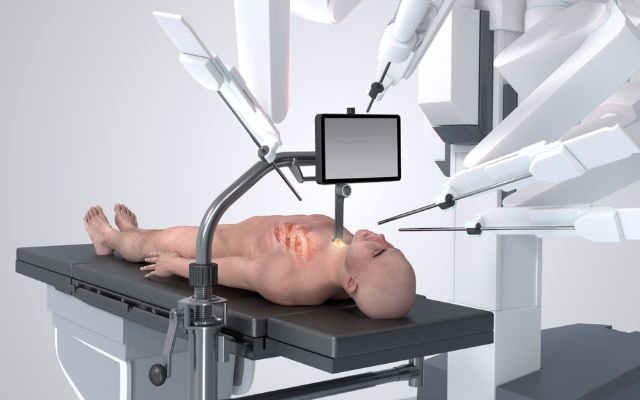
Scotland has further led the way in executing the first clinical cases of robotic aortic valve replacement (AVR) through a tiny incision in the neck, and this approach could potentially be applied to a wide range of cardiothoracic procedures.
Three out of four cardiac centres in Scotland use the innovative technology of Glasgow-based CardioPrecision, a spinout of InnoScot Health, NHS Greater Glasgow and Clyde, and the Golden Jubilee National Hospital.
Last year, the world leader in transcervical access for the treatment of structural heart disease successfully extended its robotic-assisted procedure to patients with the use of its CoreVista Robot Enabling Platform.