The storm that killed the Opportunity rover would not have knocked the hat off your head.
Winds in the biggest Martian storms top out at about 95 kilometres an hour, and because the air is only about one percent as dense as ours, that arrives as a shove rather than a blow. Michael Smith, a planetary scientist at NASA’s Goddard Space Flight Center, made this point in a NASA feature on how badly science fiction handles Martian weather, noting that nothing much gets torn off its mounting up there. What gets you is the dust itself, which is fine, faintly electrostatic, and clings to whatever it touches like packing foam.
How a regional storm swallowed a planet
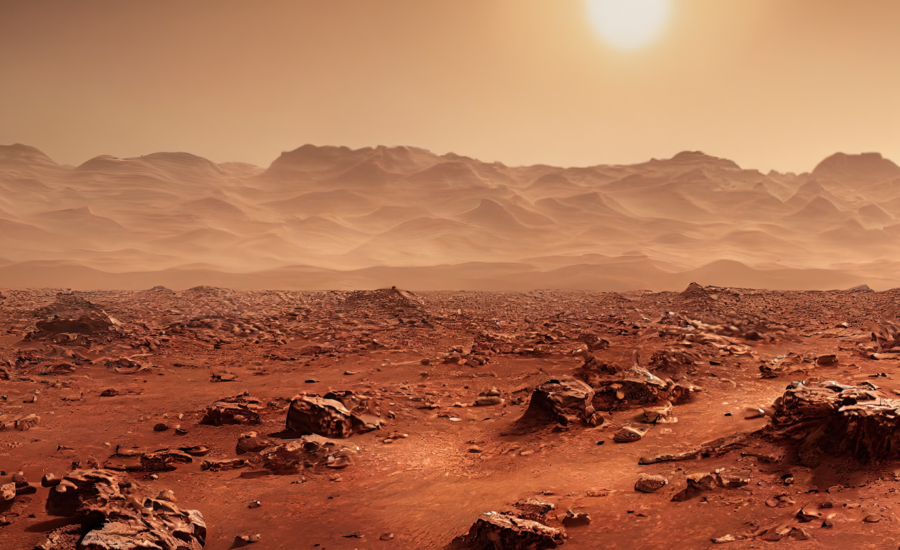
The Mars Reconnaissance Orbiter first picked up the disturbance on 30 May 2018. Within about a week it covered more than 18 million square kilometres, an area larger than North America. By 12 June it had spread across 35 million square kilometres, a quarter of the planet, and on 19 June, Bruce Cantor of Malin Space Science Systems declared it a planet-encircling event, per JPL’s rolling status reports on the storm. Opportunity sat underneath it, parked in Perseverance Valley.
These storms carry their own off switch. Sunlight warms the surface, warm air rises and takes dust with it, the airborne dust absorbs more sunlight, more air rises, and the loop runs until the sky is too thick for much light to reach the ground that was driving the whole thing. Smith is candid that nobody knows why the gaps between planet-wide storms run as long as they do, something like three Mars years, or about five and a half of ours. Maybe the dust supply needs time to redistribute. Maybe it is luck.
What darkness costs a solar-powered robot
Dust in the Martian sky is measured as opacity, written as tau. A typical value above Opportunity’s patch of ground was 0.5. At the height of the storm, tau over Opportunity’s location climbed to an estimated 10.8, past the point where engineers could take an accurate reading at all, as documented in JPL’s coverage of the storm’s growth. Curiosity, on the far side of Mars and unbothered because it runs on plutonium rather than sunlight, peaked at just above 8.0, the highest its own instruments had ever recorded. As JPL’s own education team documented, the murk over Opportunity was thick enough that only the caldera of Olympus Mons still poked above it.
Opportunity’s last transmission came on 10 June 2018. Engineers concluded the battery had fallen below 24 volts, tripping a low power fault that switches off everything except the mission clock, which wakes the computer now and then to ask whether there is enough charge to do anything useful. There wasn’t. The skies took roughly four months to clear.
A clock in a cold dark box, asking the same question every few hours.
The storm was also a windfall
For atmospheric scientists, 2018 was the first planet-wide storm watched by a full orbital fleet, with the Mars Reconnaissance Orbiter, MAVEN and the ExoMars Trace Gas Orbiter overhead and Curiosity reporting from the surface. Shohei Aoki and colleagues, writing in the Journal of Geophysical Research: Planets, tracked water vapour climbing to about 100 kilometres while the dust was up. Modelling at the Royal Belgian Institute for Space Aeronomy suggests a reason. Lofted dust warms the middle atmosphere, ice clouds that would normally trap moisture fail to form, and water climbs to altitudes where sunlight splits it apart. The hydrogen then leaks away for good. ESA’s ExoMars team counted the 2018 storm as one of three episodes in a single Martian year that sped up water loss.
That is a mechanism traced across a handful of events and reproduced in models, not a finished account of how Mars lost its water.
The fix was to stop trusting the sky
Opportunity was built for 90 Martian days. It kept driving for more than fourteen years before the storm silenced it, and NASA didn’t close the file for another eight months, so the mission’s official span, landing to shutdown, runs to just over fifteen. Longevity like that owed something to seasonal winds that kept scouring its solar panels clean at convenient moments, and something to batteries that were absurdly good. Project manager John Callas noted they had held about 85 percent of their original capacity after more than 5,000 charge cycles, as reported by SpaceNews when the mission was formally closed on 13 February 2019. NASA’s mission summary puts the final odometer reading at 45.16 kilometres, which is still the off-Earth driving record.
Nobody has since learned to forecast one of these storms. What engineers did instead was stop building surface missions that depend on the Sun, which is a fairly graceful way of conceding that you cannot beat the weather, only decline to negotiate with it.
Standards
Space Daily articles are edited and fact-checked before publication. We use AI tools in the newsroom. See our editorial standards and masthead.