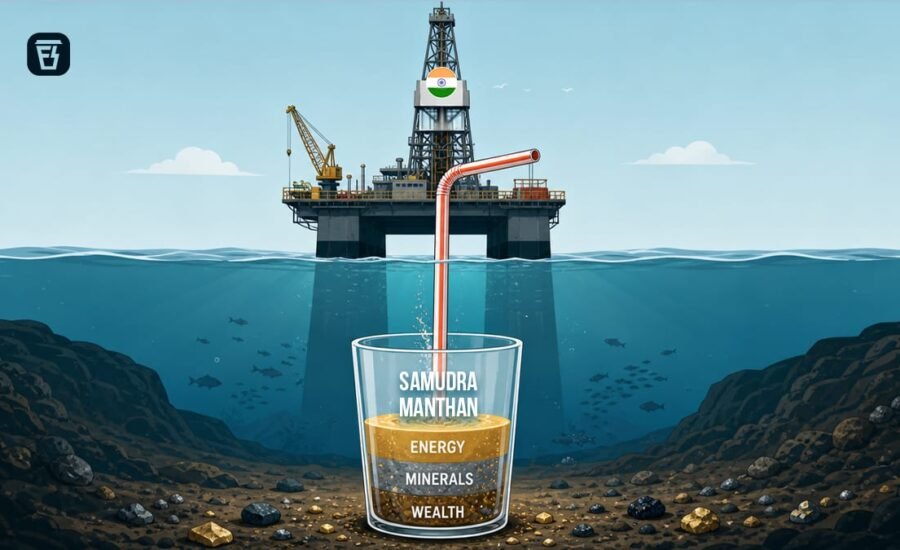
In today’s Finshots, we explain why India is investing over ₹84,000 crore into offshore exploration, and whether tapping into our vast ocean resources can unlock the country’s next massive economic growth story.
But here’s a quick sidenote before we begin. If you’re someone who loves to keep tabs on what’s happening in the world of business and finance, then hit subscribe if you haven’t already. We strip stories off the jargon and deliver crisp financial insights straight to your inbox. Just one mail every morning. Promise!
If you’re already a subscriber or you’re reading this on the app, you can just go ahead and read the story.
The Story
For decades, India treated the ocean around it as little more than a vast highway for trade. Ships sailed through Indian waters carrying crude oil, manufactured goods and other essentials, connecting India to the rest of the world. But beyond managing ports and shipping lanes, policymakers paid surprisingly little attention to the economic potential hidden beneath the waves.
However, that mindset is beginning to change.
The government recently approved the ₹84,084 crore Samudra Manthan National Offshore Exploration Scheme. At first glance, it looks like a straightforward oil and gas programme aimed at reducing India’s dependence on imported crude. The plan includes large-scale seismic surveys, deepwater exploratory drilling and new offshore infrastructure, with the ambitious goal of discovering more than 600 million metric tonnes of oil equivalent.
But Samudra Manthan isn’t simply about handing oil companies a cheque to drill more wells. It’s part of a much bigger shift in how India sees the ocean not merely as a transport route, but as an economic asset capable of supporting entire industries.
In other words, it’s an attempt to lay the foundations for India’s Blue Economy.
Before we get there though, let’s understand why the government felt the need to launch this scheme in the first place.
You see, offshore exploration is one of the riskiest businesses in the world. Companies spend millions of dollars drilling wells deep beneath the seabed without knowing whether they’ll discover commercially viable reserves. Unsurprisingly, that uncertainty has kept large parts of India’s offshore basins relatively unexplored.
Samudra Manthan tries to change that equation.
Instead of leaving companies to shoulder all the early-stage risk, the government will fund large-scale seismic surveys to generate better geological data, share part of the cost of high-risk exploratory drilling, build common offshore infrastructure that multiple projects can use, and encourage domestic manufacturing of offshore equipment and engineering services. Here’s the proposed budget:
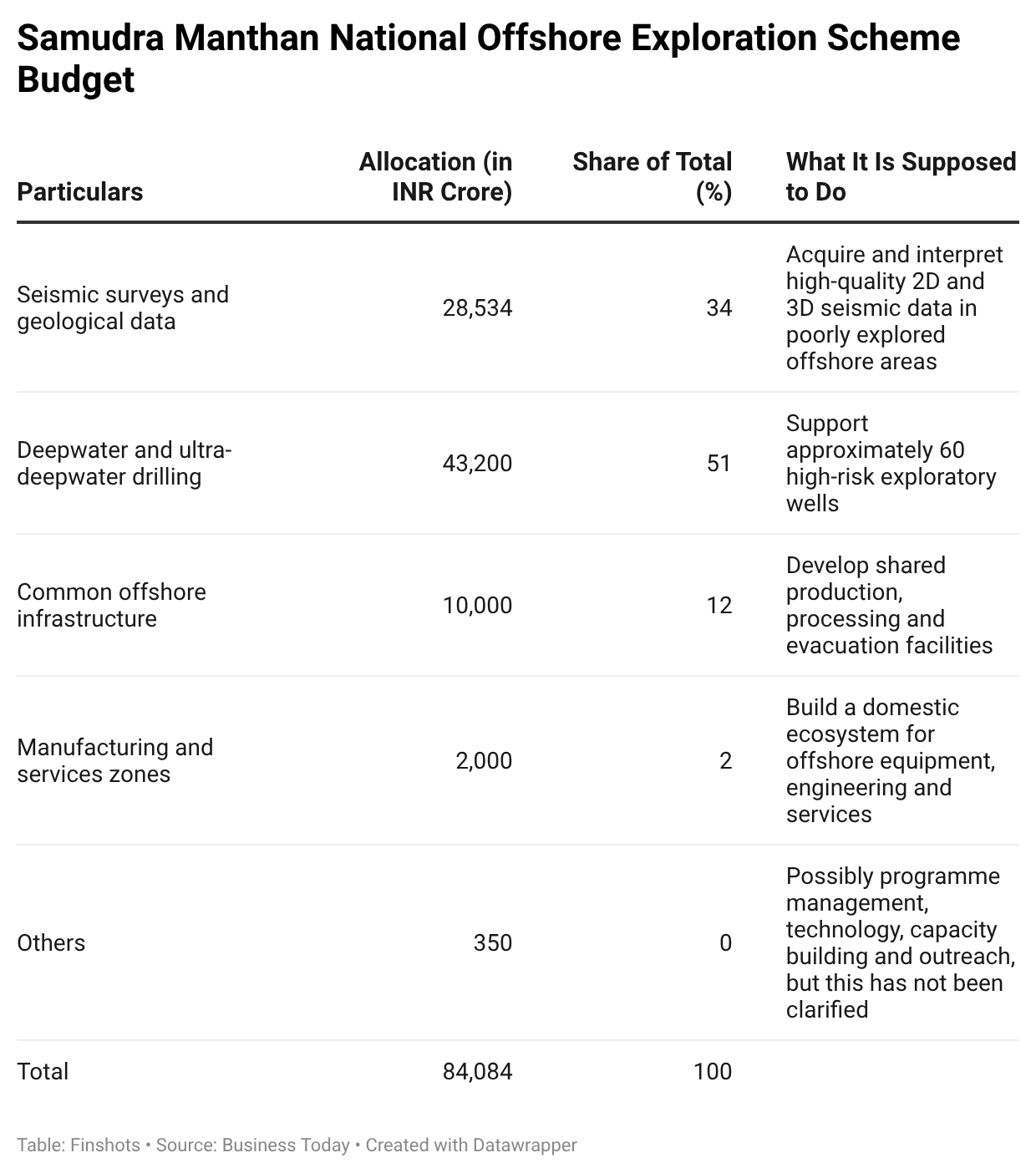
This approach has benefits that go far beyond discovering a few new oil fields. Better geological data makes future exploration more attractive. Shared infrastructure can make even smaller discoveries commercially viable. And building domestic offshore capabilities reduces India’s dependence on foreign technology and contractors. Even unsuccessful drilling improves our understanding of the seabed, making future discoveries easier and cheaper.
But if you step back and look at the broader picture, you’ll see that Samudra Manthan is only one piece of India’s growing ambition to build what policymakers call the Blue Economy.
Unlike the Green Economy, which focuses on reducing emissions and expanding renewable energy on land, the Blue Economy asks a different question: How do you generate economic growth from the oceans without damaging marine ecosystems?
For India, that’s a question worth asking for an economic upside is staggering. To put things in perspective, the country has a coastline stretching over 7,500 kilometres, an Exclusive Economic Zone spanning more than 2 million square kilometres, and sits along some of the world’s busiest maritime trade routes. Yet much of this vast maritime wealth has remained underutilised.
And the opportunity extends far beyond oil.
Sure, hydrocarbons remain important because India imports nearly 90% of its crude oil. But oil is only one part of the puzzle.
The same waters could support offshore wind farms capable of generating electricity when solar power naturally tapers off in the evening. The seabed contains valuable deposits of nickel, cobalt, manganese and rare earth elements. These critical minerals have become essential for electric vehicles, batteries and renewable energy infrastructure.
The ocean is also becoming an important piece of digital infrastructure. Undersea fibre-optic cables already carry almost all international internet traffic, while companies around the world are exploring offshore data centres to tackle the enormous power and cooling requirements of artificial intelligence.
Then there are opportunities in modern ports, shipbuilding, marine biotechnology, sustainable aquaculture and coastal tourism. Put together, they suggest that the ocean could become an entirely new engine of economic growth.
Of course, turning that vision into reality won’t be easy.
Offshore projects demand enormous amounts of capital, sophisticated technology and patience. Whether it’s drilling thousands of metres below the seabed or building offshore wind farms, these projects often require years of investment before generating any meaningful returns. Some opportunities, like deep-sea mining, are still commercially unproven and raise significant environmental concerns.
There are governance challenges too. Responsibility for India’s oceans is spread across multiple ministries handling petroleum, shipping, fisheries, defence, commerce, environment and earth sciences. That fragmentation often forces companies to navigate a maze of approvals before a single project can move forward.
And then there’s geopolitics. China recognised the strategic importance of maritime dominance years ago. Through the Belt and Road Initiative, it has financed ports across continents, become the world’s leading shipbuilder, expanded its commercial shipping fleet and steadily increased its presence in the Indian Ocean. In a world where trade, energy and critical minerals increasingly flow through the seas, maritime strength is becoming as much a strategic necessity as an economic one.
Viewed through that lens, Samudra Manthan begins to look more than a simple oil exploration scheme. It’s an investment in the capabilities needed to build a broader maritime economy. The seismic mapping, offshore engineering expertise and specialised supply chains developed today for hydrocarbons could eventually support offshore wind farms, subsea communication networks, carbon capture projects and deep-sea scientific research.
Ultimately, India’s coastline won’t become an economic powerhouse simply because it exists. Unlocking its potential will require patient capital, better coordination across government agencies, strong environmental safeguards and continuous investment in specialised maritime technology.
But if India gets that execution right, the Blue Economy could do for the country’s coastline what the IT revolution did for inland cities like Bengaluru — transforming the ocean from a trade route into one of India’s most important engines of economic growth.
Until then…
If you liked this story on how India is beginning to explore the ocean & the oceanbed, share it with your friends, family or even strangers on WhatsApp, LinkedIn, and X.
Myth Alert: I’m Too Young to Buy Life Insurance!
The other day, one of our founders was chatting with a friend who thought life insurance was something you buy in your 40s. He was shocked that it was still a widely held belief.
Fact: Life Insurance acts as a safety net for your family. The younger you are, the cheaper it is. And the best part? Once you buy it, the premium remains unchanged no matter how old you get.
Unsure where to begin or need help picking the right plan? Book a FREE consultation with Ditto’s IRDAI-Certified advisors today.