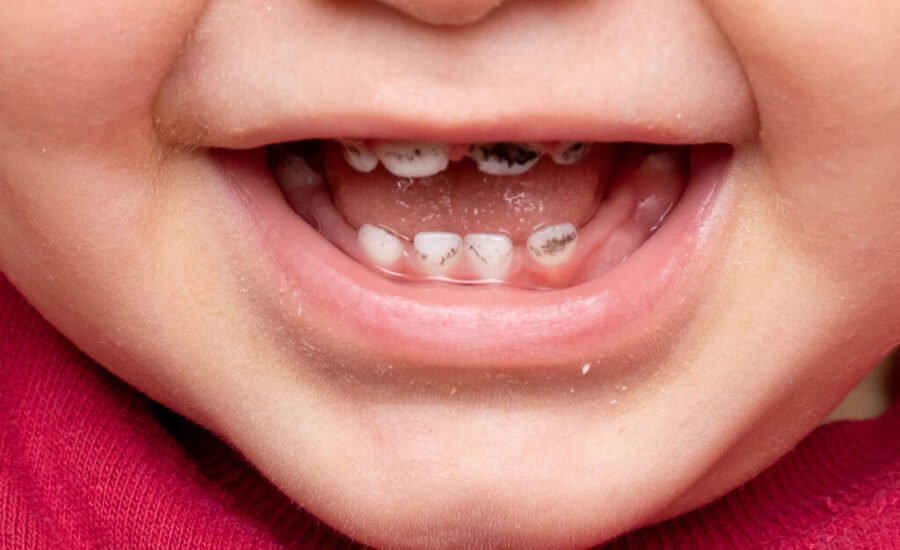
ANN ARBOR, Mich., US: Although silver diamine fluoride (SDF) has been used internationally since the 1970s to arrest caries, clinical data on its use in children younger than 3 years has remained limited. Just recently, a large randomised clinical trial has found that 38% SDF can safely and effectively arrest cavitated dentine carious lesions in young children with severe early childhood caries. The study was designed to provide evidence to support regulatory approval by the US Food and Drug Administration (FDA) for the use of SDF to arrest caries in young children.
In the US, SDF was cleared as a medical device for treating dentine hypersensitivity in adults in 2014, but its use for caries arrest remains off-label. However, both the American Academy of Pediatrics and the American Academy of Pediatric Dentistry have issued guidance on SDF, and its paediatric use has increased, particularly since the COVID-19 pandemic.
In the trial, the researchers enrolled 830 children younger than 6 years with severe early childhood caries. Participants were recruited in a range of medical, dental and school-based settings and were randomly assigned to receive either 38% SDF or a placebo. The treatments were applied at baseline and again after six months.
At three, six and eight months, lesion arrest rates ranged from 50% to 58% in the SDF group and from 17% to 23% in the placebo group. No differences in dental pain were observed between the groups, and the frequency of treatment-related adverse events was similar.
In light of the findings, the researchers concluded that SDF offers a practical, minimally invasive alternative when conventional restorative treatment is difficult. “This is a very effective and safe treatment—even in children as young as 1,” lead author Dr Margherita Fontana, Clifford Nelson Endowed Professor of Dentistry at the University of Michigan School of Dentistry, said in a press release. According to Prof. Fontana, SDF may be particularly valuable for very young children, older adults, people with developmental or physical disabilities, patients with severe dental anxiety and others who cannot easily access or tolerate conventional dental treatment.
Evidence supporting wider use
“If we want more children and families to benefit from this treatment, we need rigorous evidence showing both that it works and that it’s safe. From a public health perspective, if we want broader implementation across the US, including in medical settings, we need carefully collected data in US populations, and we now have that,” Prof. Fontana said.
The researchers believe that wider acceptance of SDF could enable carious lesions to be managed in paediatric medical settings before children are able to access comprehensive dental care. “In medicine, clinicians want high-quality evidence before changing practice,” Prof. Fontana commented. “It is important to have data they can refer to because young children often see paediatricians years before they ever visit a dentist.” Broader acceptance could allow many more lesions to be treated while referral to a dental home is being arranged and before they become painful or infected or require surgery, she said.
Co-author Dr Amr M. Moursi, professor and chair of the Department of Pediatric Dentistry at the New York University College of Dentistry in the US, said that the study provides important evidence supporting wider use of SDF. However, implementation in primary care settings would depend on healthcare teams being able to identify eligible cavitated lesions reliably. Appropriate training, clinical protocols and referral pathways would therefore be required.
“Our results support FDA approval of SDF for managing arrest of tooth decay in young children. Removing SDF from off-label status would be an important innovation which could lead to increased utilisation by providers, enhanced payments by insurers and more consistent product quality,” Prof. Moursi noted.
Previously, Dental Tribune International covered a randomised clinical trial involving children aged 5–13 years that evaluated SDF against established school-based care. The two-year analysis found that an application of SDF and fluoride varnish was as effective at arresting existing caries and preventing new lesions as a combination of glass ionomer sealants, atraumatic restorative treatment and fluoride varnish. The later analysis reported nearly identical caries incidence and comparable caries prevalence in the two groups. Considered alongside these earlier results, the present findings strengthen the evidence supporting SDF as an effective and minimally invasive approach to improving children’s oral health.
The study, titled “Efficacy of silver diamine fluoride on young children with severe early childhood caries: A randomized clinical trial”, was published online on 27 July 2026 in JAMA Pediatrics, ahead of inclusion in an issue.
Topics:
Tags:

NEW YORK, US: In a recent study, researchers investigated the effectiveness of silver diamine fluoride and dental sealants in the arrest and prevention of …

NEW YORK, US: Although silver diamine fluoride remains an effective non-invasive option for treating caries, its characteristic black staining is a major …

HONG KONG, China: Functionalised tricalcium phosphate (fTCP) was developed to keep calcium and phosphate from reacting prematurely with fluoride in …

PHILADELPHIA, U.S.: Some young children experience severe dental caries that resists normal therapies. According to a recent study carried out by …

HONG KONG: According to the Global Burden of Disease study, early childhood caries affects approximately 530 million children around the world, making it …

ALEXANDRIA, Va., U.S.: Protecting children against the early onset of dental caries is something all dentists should consider a priority. According to the …

GOTHENBURG, Sweden: Research conducted by the Sahlgrenska Academy has found that children with severe overjet have a higher chance of success with …

In many parts of the world, unequal access to oral health professionals and facilities makes it difficult for communities to receive adequate care. This …

FORT MYERS, Fla., US: Although many college students recognise the impact that lifestyle choices have on oral health, minority students often have limited …

EAST LANSING, Mich., U.S.: The National Institute of Dental and Craniofacial Research has recently awarded GreenMark Biomedical a grant to support the …

COLOGNE, Germany: Whereas caries in adults and adolescents in Germany is declining, research has found that about 14 per cent of 3-year-olds in the country …
Live webinar
Mon. 3 August 2026
8:00 pm EST (New York)
Dr. Cameron Shahbazian DMD MBA
Live webinar
Thu. 6 August 2026
5:00 pm EST (New York)

Dr. Daniel Fernando Zabaleta Díaz
Live webinar
Tue. 11 August 2026
1:00 pm EST (New York)

Dr. Bruce McFarlane Certified Specialist in Orthodontics Fellow: Royal College of Dentists of Canada Diplomate: American Board of Orthodontics
Live webinar
Tue. 18 August 2026
7:00 pm EST (New York)
Prof. Dr. Wael Att, Dr. Kubra Kundak, Dr. Acela Martinez
Live webinar
Mon. 24 August 2026
2:00 pm EST (New York)

Alejandro Uribe Marioni DDS, MSc, PhD
Live webinar
Thu. 27 August 2026
2:30 pm EST (New York)

Cat Edney
Live webinar
Thu. 27 August 2026
8:00 pm EST (New York)

Dr. Allen Wong DDS, EdD, DABSCD